Thursday, March 24, 2011
Asians in the Library: A Rant
By now I’m sure some of you have heard of the “Asians in the library” rant by UCLA student, Alexandra Wallace. In just under 3 minutes, Alexandra manages to lump millions of Asians into a mass of defenseless, rude, unassimilated and poorly brought up people. If you haven’t seen the video, she complains that “all the asians” talk on the phone in the library, bring their family members over all the time, and and are all-around ill mannered. In quite apparent frustration, she attempts to remind them, “if you’re going to go to UCLA, use American manners.” She relegates every Asian language to three words: “Chingchong, linglong tingtong,” and then goes on to describe herself as a nice, polite, American girl who always asks the Asians in the library to be quiet.
You’ve also probably heard about the recent earthquake followed by a tsunami in Japan--causing indescribable damage, and killing almost 10,00 people so far, with another 16,000 missing. This girl brushes the natural disaster off as the “tsunami thing,” and saying that though she knows it sounds horrible, people shouldn’t be in the library checking on their families anyways--they should go outside and do it.
This is a prime example of pathos gone wrong. Perhaps this girl meant to get--support? sympathy? for her tribulations.Though her video did elicit passion, it was one filled with largely outrage and fury. Like the general public, I wasn’t able to identify with her at all but instead felt sickened by her lack of education and compassion, particularly about her flippant comment about the tsunami in Japan. Coupled with weak logos (are we really to believe every single Asian talks on the phone in the library and no one else does?) and nonexistent ethos (its hard to be persuaded by someone peppering their argument with “like,” and for me, it was hard to even find her character likeable), this video was an overall rhetorical failure.
On a semi-unrelated note, there has been, obviously, a huge, negative response to this girls video; hateful comments and parody videos have sprung up everywhere, and Alexandra has purportedly received death threats. As an assimilated American with Asian heritage, this video was especially provoking for me. Though the video obviously disgusted me, it made me just as sad to see comments such as “she’s blonde...she doesn’t know any better” or “dumb blondes don’t go to the library,” with these people realizing that though she made horrible stereotypes, they are, by criticizing her like this, furthering others.

Thursday, March 17, 2011
Revisiting the Past
“friday was a half day =]
we went out for lunch. like
me lea cason molly kimmy. and other people
and then we just like walked around.
(i saw the pole i walked into last time =])
they all made fun of me though. haha lol
and then. i went to leas. and saw her kittens
and guess what.
THEYRE SO CUTEEE =]
like. tiny. and orange. i like the all orange one the best.
because. they were like. really cute =]”
This was just one of the incredibly well thought out and intellectually stimulating blog posts I wrote when I was 14. Over break, I revisited my old blog wayyy back from middle school and…
It made me kind of like, shrivel up in embarrassment. Like. For real.
Rereading what I wrote as a middle schooler definitely opened my eyes to how my rhetoric has (obviously) changed just in 4 years. I just can’t take past Rayna seriously with all her “likes” and random sentence fragments, and walking into poles (at least this hasn't changed). At the time though, I guess I thought I was just so super cool or something (I guess I can at least be thankful there wasn’t any tYpinG liK3 tHisS). It makes me wonder how our rhetoric naturally just changes like that; certainly, no one sat me down and told me, “Rayna, talking like that does not make you cooler, smarter, or more grown up. Stop it,” though I wish they did. Is it learning more in school? Reading more? Following our older siblings examples? Or just plain growing up?
Maybe it’s just a combination of all these things, and I’m willing to bet it doesn’t just end at 18. Maybe in 50 years 68 year old me will be reading this post and cringing in embarrassment over past me once again.
Or maybe not, because this time I think I’ve really nailed it; I’m just so super cool now.
Thursday, March 3, 2011
Ethos failure
“Want to steal a house? It’s completely legal!”
With the deluge of spam email I regularly get, I often guide my mouse to “delete forever” without a second though. Today though, before I could, this one particular message jumped out and caught my eye. The more I think about it, the more ridiculous it becomes; according to Merriam Webster, “steal” is defined as “to take the property of another wrongfully and especially as a habitual or regular practice.” Somehow, legal stealing just doesn’t make sense to me. Sure, the different wording caught my attention, which is surely the first goal of rhetors, but after trying and failing at figuring out exactly what they were trying to say by this, I wouldn’t have wanted to give these people my own name, let alone my address and credit card information! This completely ruined any semblance for ethos the emailers of this junk had. In addition, the ad featured no pictures or any other description; just a simple, undecipherable link. As we’ve been talking in class about how images can greatly enhance an ad or argument, this showed to me how the lack of images can completely result in failure.
This makes me think about all the other strange ads and billboards that I’ve seen that have made me think, What were they thinking?!
With the deluge of spam email I regularly get, I often guide my mouse to “delete forever” without a second though. Today though, before I could, this one particular message jumped out and caught my eye. The more I think about it, the more ridiculous it becomes; according to Merriam Webster, “steal” is defined as “to take the property of another wrongfully and especially as a habitual or regular practice.” Somehow, legal stealing just doesn’t make sense to me. Sure, the different wording caught my attention, which is surely the first goal of rhetors, but after trying and failing at figuring out exactly what they were trying to say by this, I wouldn’t have wanted to give these people my own name, let alone my address and credit card information! This completely ruined any semblance for ethos the emailers of this junk had. In addition, the ad featured no pictures or any other description; just a simple, undecipherable link. As we’ve been talking in class about how images can greatly enhance an ad or argument, this showed to me how the lack of images can completely result in failure.
This makes me think about all the other strange ads and billboards that I’ve seen that have made me think, What were they thinking?!
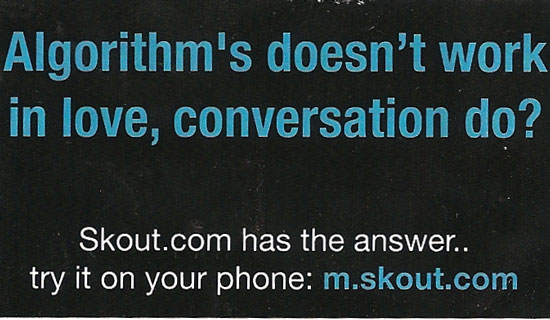 |
| case in point: would you trust your love life with this company? |
Thursday, February 24, 2011
Analyzing Ads: Ethos
 Before we talked in class about analyzing ads and the rhetoric that we can find in them, I’d never really thought about them; most of the time, I’ll just tune them out but there are some ads that just stick out. Some that are so annoying I can’t get them out of my head, and others that are persuasive and make me feel involved. I never really thought why this happens though. Now that we’ve done these ad analyses though, it’s a lot easier (and more entertaining) to pick out what advertisers are trying to sell in addition to their product, instead of just sitting there and waiting for the onslaught of commercials to end.
 The speeches we heard today and Tuesday really made me think especially about how advertisers use ethos. Almost everyone’s seen the Got Milk? campaign ads depicting celebrities with a milk mustache- if Hayden Panettiere drinks milk, so should I, right? I have to admit though, that celebrity endorsements don’t usually persuade me to buy a certain product; even though they’re famous, I can’t really trust their endorsement, especially if I know they’re being paid for it. I have noticed however, that in Asia, ads feature celebrity endorsement almost everywhere, from cell phones to bread. What makes this use of ethos so much more prominent? From what I’ve heard and seen in the news in Asia, celebrities are held to much higher standards than they are in America--if they’re involved in a scandal, it’s much harder for them to bounce back into the spotlight. Thus, it makes sense that ethos-based celebrity endorsed ads are much more common in Asia; celebrities are expected to be more “role-model” type figures.
Thursday, February 17, 2011
So I Guess I'm Going to Hell?
I’m sure many of us by now have heard preachers often found outside of Willard, the Hub, or somewhere downtown and seen the white “The World is Ending” van with its bullhorn accompanied speaker creeping up Shortlidge. A few weeks ago I was waiting to cross College Ave when I noticed a man waving his Bible around and shouting, “SINNERS will go to hell...UNBELIEVERS will go to hell...WHORES will go to hell…” As I was watching him, he paused and we made brief eye contact. It was cold--one of those days where I often feel like I’m fighting a losing battle against the wind and oh! there goes my scarf again--so I looked at him and said, “Aren’t you cold?” He glared at me. “YOU will go to hell.”
Now, I’m not here to blast anyone’s personal beliefs, but when I think about it, this man used rhetoric in the least effective way I can possibly imagine. He wasn’t talking to any of us, but rather was talking (or shouting) at us. He did make an appeal towards pathos, probably hoping to instill in us a fear of hell, but this also proved to be unsuccessful, at least for me, because his use of ethos was nonexistent. All I could think of as he told everyone around him that they were going to hell was Who is he to tell us this? How do I know how morally upright this man is? Maybe he is a sinner, an unbeliever, a whore. The very fact that he was screaming at all of us simply hurt his ethos.
We’ve also learned about how important it is to connect with your audience. After all, if your audience isn’t listening to you, what’s the point? This is another mistake this preacher made. He didn’t try to create any sort of closeness with his “audience;” if anything, he pushed them even farther away by speaking down to them and acting condescending. In today’s world, religion can be such a hot topic, and one must be careful how they phrase their words if they want to convince someone. Perhaps his words will hold sway over someone else, but for me, “You’re going to hell” just doesn’t cut it.
Now, I’m not here to blast anyone’s personal beliefs, but when I think about it, this man used rhetoric in the least effective way I can possibly imagine. He wasn’t talking to any of us, but rather was talking (or shouting) at us. He did make an appeal towards pathos, probably hoping to instill in us a fear of hell, but this also proved to be unsuccessful, at least for me, because his use of ethos was nonexistent. All I could think of as he told everyone around him that they were going to hell was Who is he to tell us this? How do I know how morally upright this man is? Maybe he is a sinner, an unbeliever, a whore. The very fact that he was screaming at all of us simply hurt his ethos.
We’ve also learned about how important it is to connect with your audience. After all, if your audience isn’t listening to you, what’s the point? This is another mistake this preacher made. He didn’t try to create any sort of closeness with his “audience;” if anything, he pushed them even farther away by speaking down to them and acting condescending. In today’s world, religion can be such a hot topic, and one must be careful how they phrase their words if they want to convince someone. Perhaps his words will hold sway over someone else, but for me, “You’re going to hell” just doesn’t cut it.
Thursday, February 10, 2011
"Hi, My Name is Rayna and Blah Blah Blah...?"
After a string of Christmas shopping, back to back (to back) birthdays, textbook buying, and all around spending, it's come to my attention in the past few months that...I've become the typical broke college student.
It turns out I'm not so good at job hunting (Sure, I went and got all these applications- that's work enough, so I think I'll just let them sit on my desk until I feel like filling them out, and what?! They're not hiring anymore??) but after this happened numerous times, I finally forced myself to get an application, fill it out, and turn it in the next day. You can hold your applause.
My job at Penn State Lion Line seems pretty simple; just call Penn State Alumni and chat with them, segueing into a request for not a donation, but a “gift.” I’ve realized that much of my job centers around rhetoric. It isn’t as simple as picking up the phone and saying, “Hi I’m Rayna, wanna give Penn State some money?” Lion Line stresses the importance of being able to connect to your audience--though there is a general gist of what we say to each person, every conversation with every alumni will be different, because they’ll respond in different ways, and we have to use what they say to us to determine the best way to use that to ask for money.
For example, if I ask someone what they studied at Penn State, they might say they studied Psychology, found in the College of Liberal Arts. As a History major, I can respond by saying I’m a Liberal Arts major as well, going off of what I know and like about it (establishing ethos). If the conversation moves onto Penn State overall, I can talk about what a great school Penn State is, and how I love all the opportunities that are offered, and the reason I could come is because I got a scholarship from alumni and am so grateful to them for their generosity (establishing pathos). If this fails to work, I can move on to logos--“Did you know that last year over 70,000 alumni contributed to Penn State, ranking us as the leading university in the number of alumni donors?”
In this sense, rhetoric for my job is really important; from what we choose to say and how we say it to what specific words we should and shouldn’t use. As we learned today in class, our goal is to establish a relationship with our audience, closing the distance between us.
It turns out I'm not so good at job hunting (Sure, I went and got all these applications- that's work enough, so I think I'll just let them sit on my desk until I feel like filling them out, and what?! They're not hiring anymore??) but after this happened numerous times, I finally forced myself to get an application, fill it out, and turn it in the next day. You can hold your applause.
My job at Penn State Lion Line seems pretty simple; just call Penn State Alumni and chat with them, segueing into a request for not a donation, but a “gift.” I’ve realized that much of my job centers around rhetoric. It isn’t as simple as picking up the phone and saying, “Hi I’m Rayna, wanna give Penn State some money?” Lion Line stresses the importance of being able to connect to your audience--though there is a general gist of what we say to each person, every conversation with every alumni will be different, because they’ll respond in different ways, and we have to use what they say to us to determine the best way to use that to ask for money.
For example, if I ask someone what they studied at Penn State, they might say they studied Psychology, found in the College of Liberal Arts. As a History major, I can respond by saying I’m a Liberal Arts major as well, going off of what I know and like about it (establishing ethos). If the conversation moves onto Penn State overall, I can talk about what a great school Penn State is, and how I love all the opportunities that are offered, and the reason I could come is because I got a scholarship from alumni and am so grateful to them for their generosity (establishing pathos). If this fails to work, I can move on to logos--“Did you know that last year over 70,000 alumni contributed to Penn State, ranking us as the leading university in the number of alumni donors?”
In this sense, rhetoric for my job is really important; from what we choose to say and how we say it to what specific words we should and shouldn’t use. As we learned today in class, our goal is to establish a relationship with our audience, closing the distance between us.
Friday, February 4, 2011
Those Little Things...
Everyone knows by now that President Barack Obama visited Penn State today, urging for a new and more efficient energy plan. Though I would have jumped at the opportunity to see the President speak, his visit coincided with Chinese New Year; a day I have always spent in New York, visiting family.
And so as I spent the day here in Manhattan, I also spent the day experiencing Obama's visit vicariously through Facebook, as friends posted statuses and uploaded pictures. Some expressed dismay and outright indignation at the inconvenience of getting to class, while others e-screamed their excitement at such an event. In the multitude of Obama-related social networking information, one status in particular made me do a double-take.
“Did he really just say “Nittaly Lions” again?”
Apparently back in 2008, Obama referred to us Nittany Lions as the “Nittaly Lions.” At a state school renowned for its school spirit, this undoubtedly caused annoyance if not anger-probably now even more so if Obama really did say it again today. It’s interesting to note that after three years and out of Obama’s whole speech today, this is the one thing the student remembered chose to comment on. This made me realize how much the effect of your message depends so much on how you present it to your audience.
We’ve learned how important it is to be able to connect with your audience--after all, you may have the best speech with the most convincing arguments, but if you can’t adequately convey this to someone what good will it do? This one incident, this one tiny slip of tongue made me realize how, in presenting and using rhetoric, everything counts. It doesn’t do to simply look presentable and speak fluidly alone if your audience is invested in what you are saying (though they still are essential in establishing ethos). On one hand, in the grand scheme of things, the one letter difference really doesn’t matter at all. On the other hand, to some people, this simple matter of knowing where you are speaking and knowing what is important to you audience can make or break a speaker’s ethos. It obviously broke it for this student found, who found it most important to comment on this one slip of tongue, especially since it happened twice, rather than anything Obama had on his agenda. For me though, I’d say we’re all human and we’re all going to make mistakes. As long as Obama knows more about his energy efficiency plan than he does about the Nittany Lions, I’d say we can brush off his little mistake.
And so as I spent the day here in Manhattan, I also spent the day experiencing Obama's visit vicariously through Facebook, as friends posted statuses and uploaded pictures. Some expressed dismay and outright indignation at the inconvenience of getting to class, while others e-screamed their excitement at such an event. In the multitude of Obama-related social networking information, one status in particular made me do a double-take.
“Did he really just say “Nittaly Lions” again?”
Apparently back in 2008, Obama referred to us Nittany Lions as the “Nittaly Lions.” At a state school renowned for its school spirit, this undoubtedly caused annoyance if not anger-probably now even more so if Obama really did say it again today. It’s interesting to note that after three years and out of Obama’s whole speech today, this is the one thing the student remembered chose to comment on. This made me realize how much the effect of your message depends so much on how you present it to your audience.
We’ve learned how important it is to be able to connect with your audience--after all, you may have the best speech with the most convincing arguments, but if you can’t adequately convey this to someone what good will it do? This one incident, this one tiny slip of tongue made me realize how, in presenting and using rhetoric, everything counts. It doesn’t do to simply look presentable and speak fluidly alone if your audience is invested in what you are saying (though they still are essential in establishing ethos). On one hand, in the grand scheme of things, the one letter difference really doesn’t matter at all. On the other hand, to some people, this simple matter of knowing where you are speaking and knowing what is important to you audience can make or break a speaker’s ethos. It obviously broke it for this student found, who found it most important to comment on this one slip of tongue, especially since it happened twice, rather than anything Obama had on his agenda. For me though, I’d say we’re all human and we’re all going to make mistakes. As long as Obama knows more about his energy efficiency plan than he does about the Nittany Lions, I’d say we can brush off his little mistake.
Subscribe to:
Posts (Atom)